If you discover first aid just from posters on a staffroom wall surface, you will certainly develop blind spots. Genuine emergency situations hardly ever match neat diagrams. They take place in confined kitchens, on damp pavement, in noisy gyms, under the stress of a hundred decisions. Over years of first aid training and on-the-ground feedback, I have seen little errors snowball and simple, effective activities save lives. The difference is not heroism. It is habit, quality, and useful judgment.
This overview separates frequent mistakes from proven strategies that hold up in the mess of real life. It does not replace a first aid course or a CPR course, and it ought to not. Skills clear up right into muscle memory when you practice them with a trainer that corrects your form and challenges your assumptions. Think about this as an area handbook you emotionally carry, a way to detect catches before you action in them.
Start with the scene, not the patient
Rushing right to the individual on the ground really feels natural and is frequently incorrect. You owe the client your existence, however you also owe them continuity of care. If you are injured, distracted by dangers, or separated from help, your capability to help collapses quickly.
Take a breath and check. Traffic does not quit because somebody swung. Electricity does not dim due to the fact that you discovered a torn line. A canine will certainly protect its proprietor, also if that proprietor is in distress. In a manufacturing facility, a maker does not grow principles. This first, fast danger evaluation comes to be a behavior with technique, and it sets the tone for every little thing that follows.
I worked with a sporting activities club where a well-meaning colleague dashed into the roadway to reach a flattened jogger. He nearly created a second casualty. A different volunteer took three seconds to wave down autos and position cones we kept in a package. Those seconds transformed the scene from disorderly to controlled. Your checklist is easy: what can injure me, what can injure various other onlookers, and what can make this worse.
Calling for help, the right way
People still undervalue how details you must be when you call emergency situation services. Call-takers are educated to triage, however they are not on scene with you. Obscure declarations lose time. When you dial, start with your specific location, including sites or GPS coordinates from your phone, then what took place, after that the individual's condition.
There are two classic mistakes below. The initial is delegating the call with a yell into a group. If you do not designate an individual, you have not delegated in all. The second is hanging up prematurely, commonly due to the fact that you really feel guilty speaking while others float. Stay on the line till they reject you. They can train you through CPR or bleeding control. If you are alone with a non-breathing grownup, telephone call first, then start upper body compressions on speakerphone.
In remote locations, you will certainly discover hard restrictions. Response time can stretch past 20 minutes. If you trek, assist journeys, or take care of exterior events, obtain a first aid certificate that covers remote treatment and bring what you require to bridge that space. A good first aid and CPR course will certainly force you to plan for those lengthy minutes.
Airway and breathing, without the myths
Not every fainting spell requires a dramatic respiratory tract maneuver, and not every seizure suggests you need to put something in the mouth. Actually, placing anything into a seizing person's mouth threatens; it takes the chance of damaged teeth and goal. Secure the head, roll onto the side when snagging quits, and time the occasion. If it lasts past 5 minutes, or if there are repetitive seizures without healing, this is a clinical emergency.
Gasping is one more source of confusion. Agonal breaths look like the body trying to breathe, yet they are not effective. If someone is unresponsive and wheezing off-and-on, deal with that as not breathing. Beginning CPR. The feeling that you are doing excessive will certainly attract you to quit. Maintain going till trained assistance takes over or the person shows signs of life.
For choking, the reaction to consume water is difficult to shake and generally makes it even worse. If they are coughing vigorously, let them try to clear it. If the cough deteriorates or they can not speak, execute back strikes and stomach drives. The series is awkward the first time, which is a strong factor to take cpr training where you can exercise on manikins.
CPR: compressions that matter
I have seen lots of sympathetic rescuers press quickly and superficial in a panic. 2 guidelines bring a lot of the advantage: depth and recoil. Compressions for an adult should go to the very least 5 centimeters, concerning a third of upper body depth for a kid, and a little bit much less for a baby, making use of 2 fingers rather than hands. Allow the breast surge fully between compressions. That recoil is the heart refilling.
Mouth-to-mouth is not required for lay rescuers on unidentified adults. If you are trained and eager, breaths can assist, but premium compressions take priority. Lots of people avoid compressions to adjust an obstacle tool, or they stop briefly for long breaths. Those stops briefly cost perfusion. Go for a price of 100 to 120 per minute, and maintain disturbances under 10 seconds.
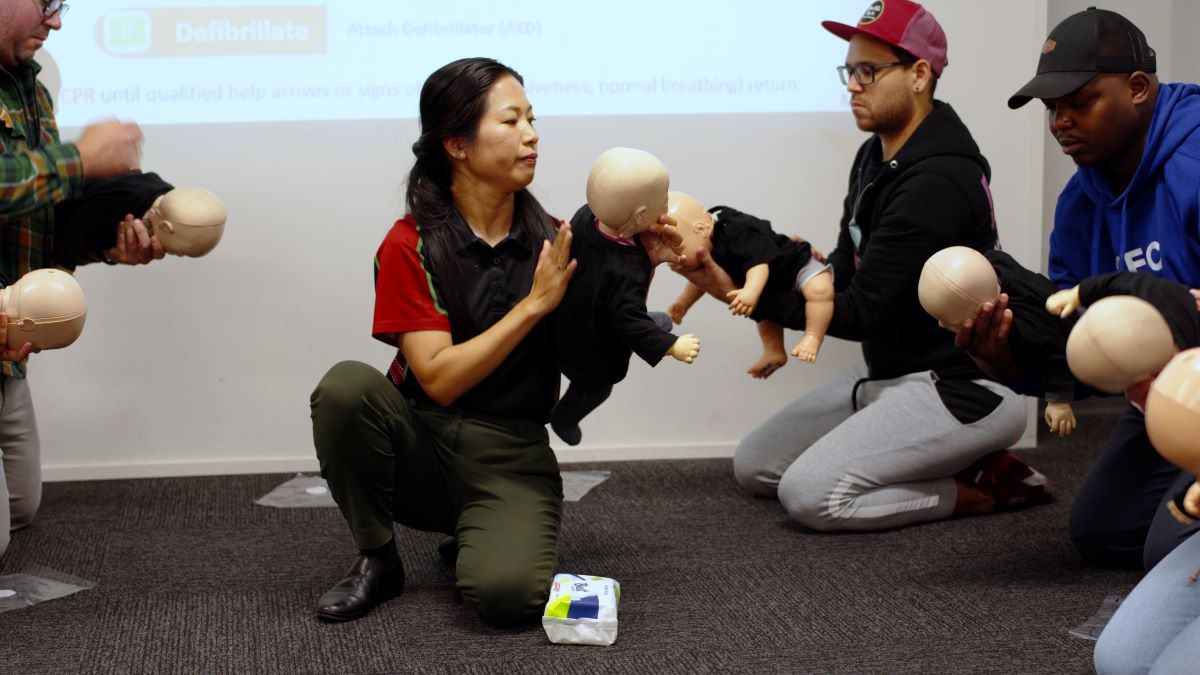
Practice is whatever right here. A cpr correspondence course each year maintains your hands straightforward. Many training centers use manikins with responses devices that show you what reliable compressions feel like. The weight, the rhythm, the perseverance to keep going with minutes that seem like hours, these do not come from reading.
AEDs: straightforward, safe, and underused
An automated outside defibrillator talks you via its own use. It will certainly not stun a beating heart. Both major errors are waiting to open up package and falling short to reveal the breast. Glue pads must adhere to skin. If the upper body is hirsute, utilize the razor located in most AED sets. First Aid Course Hobart If it is wet, dry swiftly to make certain adhesion. If there is a drug patch, remove it with a gloved hand and clean the area.
Do not let the presence of a pacemaker lump under the skin stop you. Area the pad at least an inch away from any kind of dental implanted device. And clear spectators before a shock: hands off, loud voice, fast check. It appears theatrical, yet in a congested health club or workplace, someone always attempts to "help" by keeping a hand on the shoulder. A quick, practiced news avoids an unintentional shock to a helper.
Bleeding control: pressure defeats gadgets
Fancy tourniquets and hemostatic gauze have their place, but the majority of external blood loss stops with consistent, straight stress. Not touching, not glimpsing to inspect, stagnating the pad every couple of secs. Press hard, keep pushing, and raise just if it does not trigger discomfort or risk more damage. You can make use of fabric, a folded Tee shirts, even gloved hands. Change saturated layers with even more on the top as opposed to raising the very first dressing, because you will disturb the developing clot if you keep checking.
Tourniquets conserve lives when made use of appropriately on arm or leg blood loss that will certainly not stop with stress. The common mistakes are putting them over joints, not tightening up enough, or loosening up to "allow the blood flow." Do not loosen a tourniquet once used. Keep in mind the time. A lot of business tools are intuitive if you have actually handled them once. If your atmosphere includes devices, equipment, or high-speed hobbies, obtain hands-on training with a licensed first aid pro. You do not want your very first time to be at a collision site.
Internal bleeding hides. Pale skin, great sweat, a dropping level of responsiveness, and a fast, weak pulse signal trouble after a difficult blow, especially to the abdominal area or upper body. This is not a location for natural home remedy. Keep the individual still, warm, and get assist relocating fast.
Fractures and neck injuries: do much less, better
Straightening a mangled limb looks brave in flicks and goes badly in parking area. Splint in the setting found unless there is no pulse past the injury or the skin is at threat. Incapacitate the joint above and listed below with whatever you have: board, publications, rolled-up jacket. Pad well to reduce pressure points. Check circulation, sensation, and movement prior to and after.
Neck and back injuries are typically over-suspected and occasionally tragically disregarded. The regulation is mild control, not a fumbling match. If you think a spine injury, ask the person not to move, support the head in the position you discovered it, and prevent twisting while you assess. Do not apply a makeshift collar unless you have actually been educated and have proper tools. In the real life, I have seen more injury from amateur collars than from mindful hand-operated stabilization.
Know when to unwind. A low-speed mishap with a fully alert, comfortable person that walked away might not require immobilization. On the various other hand, an autumn from a ladder with confusion or pins and needles is worthy of strict motion control. Excellent first aid training assists you sort the grey locations instead of reaching for extremes every time.
Heat, chilly, and the little mistakes that compound
Environmental injuries are built from little, easy-to-miss decisions. Heat fatigue appears like clumsiness and irritability prior to it resembles collapse. Early indicators are frustration, aches, and nausea. Relocate the individual to shade, loosen up garments, and cool them with water and air flow. Offer little sips if they are alert. Prevent ice bag over important body organs; concentrate on underarms, groin, and neck for reliable cooling. Warm stroke is different: altered mental status and a warm, commonly completely dry skin. That is an emergency, and cooling becomes hostile while you require help.
Hypothermia does not only happen in snow. Wet wind at 10 Celsius can draw warmth faster than you expect. The blunder I see most is misuse. Cold hearts are cranky. Lift and move delicately, keep the person straight ideally, and insulate from the ground. Warm the core first. Scrubing limbs or compeling hot beverages can aggravate the condition. If shivering stops and they end up being confused, you are behind the curve.
Burns: when water is your best tool
A good rule: cool the burn, not the individual. Run cool, not ice-cold, water over the location for at least 20 mins if you can. That home window expands actual benefit even when started late within two to three hours. Do not use butter, tooth paste, egg whites, or any one of the people concoctions that still circulate. They trap heat and raising infection threat. Eliminate rings or tight items early before swelling traps them, however leave stuck clothing in place and cool with it.
Blister management drives dispute. For first aid, leave blisters intact and cover loosely with a clean and sterile, non-adhesive dressing. Seek healthcare for burns larger than a palm, burns on the face, hands, feet, genitals, or over joints, and any electrical or chemical burns. Chemical burns demand immediate massive watering. Brush away dry chemicals prior to flushing to avoid activating them with water on the skin's surface.
Chest discomfort and the quiet extremes
Chest pain does not always appear like a hand clutched to the breast bone. Women, older adults, and people with diabetes mellitus might present with shortness of breath, nausea, jaw or back pain, or uncommon exhaustion. If you presume a heart event, maintain the individual calmness and still. If they have prescribed nitroglycerin, aid them take it as directed while they sit. Chewable pain killers may be proper if the individual is not allergic and has no bleeding danger background, but follow local standards and training.

A constant error is walking a person around "to get air" or driving them on your own due to the fact that calling a rescue feels like making a scene. Paramedics do more than transportation. They begin therapy and communicate with health centers en course. Cutting five minutes off the path to conclusive treatment frequently alters outcomes.
Diabetics, fainting, and the sugar trap
When someone lightheaded collapses at a party, a loads bystanders fetch juice. Sometimes that helps. In some cases it assists you really feel helpful. Without a clear history, do not pour fluid right into the mouth of a person with altered awareness. If the individual is awake adequate to ingest and you presume low blood sugar, quick sugar resources like glucose gel, a soft drink, or even honey can raise them over a bulge. If they are drowsy, slurring, or you can not wake them, do not compel food or beverage. Roll them to their side to safeguard the air passage and ask for help.
People often confuse fainting with seizures. An easy pale is quick, with rapid healing once the person is supine and blood circulation go back to the mind. A characteristic of a seizure is a post-ictal stage: confusion, headache, and fatigue that does not settle in seconds. Time the occasion, safeguard the head, and display breathing.
Allergies and anaphylaxis: rate over second-guessing
Anaphylaxis is not simply hives and swelling. Try to find breathing problem, relentless coughing, voice adjustments, throwing up, dizziness, and a feeling of doom. If the person has an epinephrine auto-injector, help them use it on the outer thigh. Do not fear "overreacting." The larger mistake is waiting as signs intensify. Epinephrine is the first-line treatment, not an antihistamine. If you provide, call emergency situation solutions and be ready to duplicate in 5 to 15 mins if signs and symptoms reoccur and you have a 2nd dose.
Parents often stow away auto-injectors unreachable to safeguard children. In method, unreachable ways pointless. Maintain them in predictable, obtainable areas and make sure caretakers and trains understand where they are. A brief first aid and cpr course that includes anaphylaxis drills pays returns here.
Head injuries: the nuance behind "simply a bump"
Not every strike to the head requires a scan, yet a couple of red flags need to activate immediate care: duplicated throwing up, aggravating headache, seizure, unusual drowsiness, confusion, a period of passed out longer than a couple of seconds, or any kind of focal weak point or numbness. For sporting activities, if you think trauma, remove the player from activity. Symptoms can appear late, over 24 to two days. Err on the side of remainder and clinical analysis. The bravado to play through it has actually sidelined even more teenagers for more periods than a careful benching ever before did.
The mistake to prevent is concentrating on the cut. Scalp wounds hemorrhage significantly, which attracts attention, while the mind below may be concussed. Control bleeding with stress, but maintain your judgment on the individual's habits, speech, and balance.
Infection control that holds up when you are tired
Gloves, eye defense, and masks feel like overkill till you wish you had them. Most first aid packages include a limited number of disposable gloves that tear easily. Take into consideration adding a pair of durable nitrile gloves in your size. Clean hands prior to and after care when possible, and use sanitizer as a bridge, not a substitute. For needlestick dangers or blood direct exposure, seek clinical recommendations very early as opposed to "waiting to see." I say this with the memory of a volunteer Provide First Aid Course Subiaco who cleaned up after a nosebleed without gloves because it really felt impolite to place them on. She invested months in follow-up testing she can have avoided.
Use obstacles for rescue breaths if you give them. If you do not have a barrier gadget, hands-only CPR remains an excellent choice for grown-up heart attack. For infants and youngsters, where hypoxia is regularly the reason, breaths supply more advantage, which highlights the worth of correct first aid and cpr courses that prepare you for pediatric scenarios.
Documentation and handover: the quiet specialist move
Write down what you see and do. Time of incident, time you started CPR, when the AED evaluated, when you applied a tourniquet or offered an epinephrine dose. This document assists paramedics and shields you legitimately. Throughout handover, talk in simple language, not jargon you half-remember. "He was unresponsive and gasping. I began compressions at regarding 5:12. AED advised a shock once. We stunned. He started breathing generally around 5:19." That is clear, helpful, and respectful.
If the occasion takes place at work or in a club, finish the event record as soon as useful. Truths discolor promptly. A clean report additionally helps your organization boost its first aid kit, AED placement, and training plan.
The role of training: why skills drift
Confidence is not skill. Many people carry a first aid certificate from years back and assume they keep in mind the essentials. Guidelines develop, and your hands fail to remember. Compression prices, deepness targets, drowning methods, and even bleeding control suggestions have actually readjusted over the last years. After educating thousands of students, I can tell you that refresher trainees often overestimate their recall of series and undervalue exactly how fatiguing correct CPR is.
This is not a scold. It is an invitation. Choose a first aid training carrier that runs scenario-based exercise with comments. Try to find mixed layouts if your schedule is tight: theory online, abilities face-to-face. If you look after a team, maintain the society by setting up a cpr course or an incorporated first aid and cpr course a minimum of every two years, ideally with shorter refresher courses every year. Individuals will turn up if you treat it as vital, not optional.
Building a kit you will in fact use
Kits stop working when they are made for magazine images rather than the truths of your life. If you instructor youth sports, stock much more immediate ice bags, cohesive bandage, tape, and sore treatment. In a workshop, include an industrial tourniquet, added gauze, and burn gel or simple cling film for covering. For hiking, weight issues. Focus on stress dressings, a triangular plaster, blister treatment, and a SAM splint you Joondalup CPR Course can shape for lots of usages. If you take care of a workplace, purchase an AED and mount it in a visible, central place with clear signage.
Rotate stock. Adhesives dry out, gloves weaken, and batteries die. Place a schedule pointer to inspect sets twice a year. After any serious use, replenish immediately. A vacant kit is a prop, not a plan.
Here is a brief, high-yield set check that fits most offices and clubs:
- Gloves that fit, great deals of gauze, tape that in fact sticks An industrial tourniquet and a pressure bandage A pocket mask or face shield for rescue breaths Instant ice bags and flexible natural bandage AED with extra pads and up-to-date battery
Coaching others on scene
One qualified rescuer is excellent. One qualified rescuer that can route three eager bystanders is much better. Your tone matters. Select jobs and appoint names. "Maya, call emergency solutions and remain on with them. Liam, bring me the AED from the lobby. Chen, wait the lift to assist paramedics." It reduces duplicate effort and relaxes the energy around you. If somebody tries to argue or hover, provide a job that aids and keeps them off the beaten track, like removing space or meeting responders at the door.
You will certainly run into the well-meaning doubter, the individual who thinks CPR breaks ribs so you should push gently, or that you should never use a tourniquet. A steady, brief description purchases you space to function: "Ribs may break, yet compressions are what circulate blood. We need depth." Conserve disputes for later.
The two-minute reset: an easy tempo that works
Emergencies compress attention. You will forget to reassess. Develop a quiet habit of a time-based reset. Every number of minutes, ask yourself: is the scene still safe, is the air passage open, is taking a breath reliable, is bleeding regulated, has the patient's level of reaction transformed, and what is the next ideal action until help shows up. This micro-check protects against tunnel vision on a clothing while the individual gets on shock, or on shock while a pad peels a moist upper body before an AED analysis.
If you have more than one trained individual on scene, button compressors every 2 mins during CPR to avoid exhaustion. Utilize the AED's prompts as a metronome for these swaps. It really feels formal initially and becomes fluid with practice.
When to tip back
Not every situation desires a helper between. Combative intoxication, group violence, harmful products, or a family in raw pain can create risks you can not alleviate without even more resources. Know your limitations and respect them. Your duty of treatment does not consist of coming to be a second person. Call early, observe, and give the very best information you can to responders. If you can make the scene more secure for experts by shutting off machinery, opening gates, or clearing a course, do that.
Choosing training that fits your reality
All first aid courses are not the same. If you manage children, ensure your first aid and cpr courses consist of pediatric web content and choking relief for infants and kids. If you manage a health club, focus on AED knowledge and exertional heat illness. Industrial websites ought to add bleeding control and crush injury circumstances. Ask suppliers about trainer experience, course dimension, and hands-on proportion. Look for cpr courses with present standards and manikin feedback.
A trusted first aid pro will certainly not overpromise. They will tell you what a lay rescuer should not try, equally as clearly as what you should. They will certainly weave in judgment, not simply actions. They will certainly let you practice until you are weary and then ask you to carry out another round, because that is exactly how genuine tiredness feels during extended CPR.
The spirit behind the skills
The finest very first aiders I understand are not adrenaline chasers. They are systematic, tranquil, and typically peaceful. They practice in their heads, they maintain their sets monotonous and practical, and they freshen their training before it goes stale. They additionally make tranquility with flaw. You will certainly forget an action one day. You will apply a dressing that slips or begin compressions slightly expensive and adjust. What counts is not remarkable choreography. It is deliberate action rooted in principles that do not change with the lighting or the noise.
Take a course. Schedule a refresher course. Place an AED where individuals collect. Show your kids to call for help. Replace the dried-out tape in your set. The remainder adheres to from those straightforward, adult choices. When the day comes, and it will be available in some form, you will certainly prepare sufficient, which is specifically what the individual in front of you needs.